

[Dec-2023] Download Real VMware 3V0-21.21 Exam Dumps Test Engine Exam Questions
New 3V0-21.21 exam dumps Use Updated VMware Exam
Advantages of Passing of VMware 3V0-21.21 Certification Exam
Advantages of becoming VCP6-DCV certified include the following:
- You'll be able to use the VCIX logo on your business cards and in other marketing materials.
- You'll receive a certificate that's good for 3 years.
- You may become eligible for a salary increase or your company may increase your salary if it is willing to pay an annual fee (USD250) for continued access to certification exams.
- You'll be able to use your certification to get more clients or a higher rate of pay.
- You'll be able to use the title “VCP” or “VCIX” after your name.
- You'll be able to prove that you are skilled at working with virtualization systems.
- You may become eligible for employment with VMware, or you may have an advantage when competing for available jobs.
- Your salary will increase if you become VCP6-DCV certified because this is a very popular title to have.
- The VCP6-DCV certification allows you to work on virtualization projects within the IT industry.
NEW QUESTION # 35
An organization's data scientists are executing a plan to use machine learning (ML). They must have access to graphical processing unit (GPU) capabilities to execute their computational models when needed. The solutions architect needs to design a solution to ensure that GPUs can be shared by multiple virtual machines.
Which two solutions should the architect recommend to meet these requirements? (Choose two.)
- A. AMD MxGPU
- B. vSGA
- C. vSphere DirectPath I/O
- D. NVIDIA vGPU
- E. vSphere Bitfusion
Answer: B,D
NEW QUESTION # 36
During a requirements gathering workshop, the customer provides the following information:
Each host has 2 × 10 GbE NIC
EtherChannel is not currently configured
No changes can be made to the physical network
Network throughput must be prioritized for defined critical services
Which two recommendations should the architect make with regard to virtual networking? (Choose two.)
- A. Use Route Based on Physical NIC Load.
- B. Use Network I/O Control with Limits.
- C. Use Network I/O Control with Shares.
- D. Use Network I/O Control with Reservation.
- E. Use Link Aggregation Control Protocol (LACP).
Answer: A,C
NEW QUESTION # 37
Refer to the exhibit.
During a requirements gathering workshop, the customer shares the following diagram regarding their availability service-level agreements (SLAs):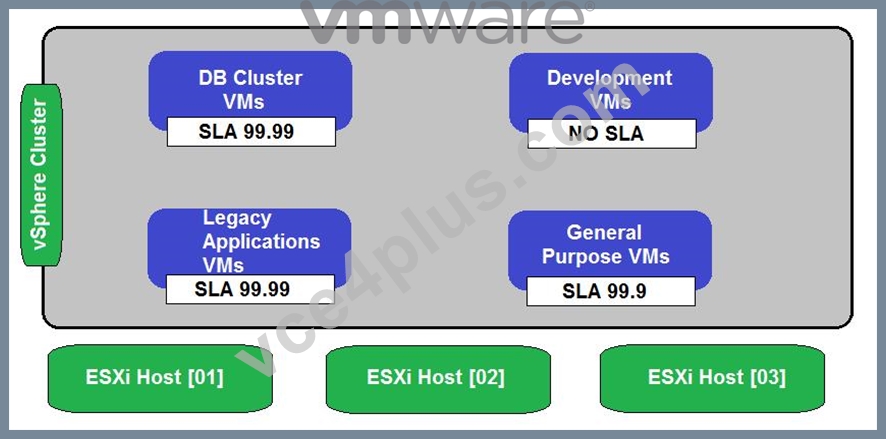
The customer wants database application level availability to always take precedence. What should the architect recommend to meet the customer's requirement?
- A. Enable vSphere HA and add a VM Override with VM Restart Priority set to Lowest.
- B. Enable Sphere HA and maintain the default settings.
- C. Enable Fault Tolerance.
- D. Enable vSphere HA and add a VM Override with VM Restart Priority set to Highest.
Answer: A
NEW QUESTION # 38
An architect is designing a new backup solution for a vSphere platform that has been recently upgraded to vSphere 7.
The architect wants the backup solution to perform the following:
Full virtual machine image backup and restore
Incremental virtual machine image backup and restore
File level backup and restore within both Windows and Linux virtual machines LAN-free backup Which functional requirement should the architect include in the design of the new backup solution?
- A. The backup solution must leverage virtual machine snapshots.
- B. The backup solution must leverage VMware vSphere Storage APIs - Data Protection.
- C. The backup solution must leverage the VMware Consolidated Backup (VCB) framework.
- D. The backup solution must leverage VMware vStorage APIs for Data Protection (VADP).
Answer: B
Explanation:
https://kb.vmware.com/s/article/1021175
NEW QUESTION # 39
An architect is creating a network design for a new vSphere environment.
Based on customer requirements, the environment must support the following types of traffic:
Management
vMotion
vSAN
Fault Tolerance
Virtual machine traffic, which cannot be impacted by other types of traffic Which design recommendation can the architect make for a resilient infrastructure with vSphere network service tiering?
- A. Use a NIC teaming policy based on the physical NIC load
- B. Use different logical networks to ensure traffic is isolated with separate VLANs
- C. Use two dedicated virtual switches with a single adapter each, dedicating one virtual switch for Management, vMotion, vSAN and Fault Tolerance traffic, and the second one for virtual machine traffic
- D. Use Network I/O Control and ensure appropriate share value is defined for different types of traffic giving priority to the virtual machines traffic
Answer: D
Explanation:
https://docs.vmware.com/en/VMware-vSphere/7.0/vsan-network-design-guide/GUID-6B00B437-53A3-4ACD-8CD7-AC9D0CE5BA8E.html
NEW QUESTION # 40
Refer to the exhibit.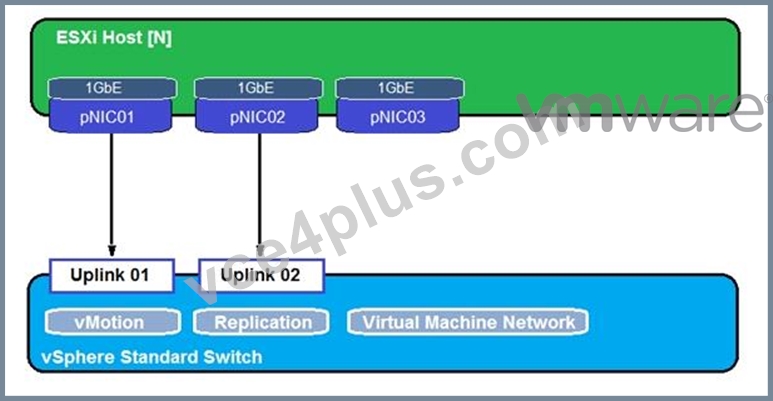
During a requirements gathering workshop, the customer shares the following about their existing ESXi host virtual networking infrastructure:
The customer confirms that:
Each ESXi host has approximately 200 virtual machines.
They want to maximize the number of concurrent virtual machine migrations.
When placing a host in maintenance mode, it takes a long time to evacuate the virtual machines.
Which two recommendations should the architect make in order to help the customer overcome their challenge? (Choose two.)
- A. Use the 3 pNICs and bundle them in a link aggregation group (LAG) configuration
- B. Create an additional standard switch with pNIC3 to use for vMotion
- C. Use 10 GbE NICs instead of 1 GbE
- D. Configure the network to use MTU for the VMotion VMKernel to 9,000 bytes
- E. Configure the network to use MTU for the VMotion VMKernel to 1,600 bytes
Answer: A,E
NEW QUESTION # 41
An architect is designing a new vSphere environment with the following resources:
600 vCPU
5,760 GB RAM
Average resource usage is:
60 vCPU
1,152 GB RAM
The design must meet the following requirements:
The environment has the ability to burst by 25%.
Each host can schedule 36 vCPUs and has 512 GB RAM.
Management overhead is 20%.
What is the minimum number of hosts required to meet the design requirements?
- A. Five
- B. Three
- C. Four
- D. Two
Answer: D
NEW QUESTION # 42
An architect is tasked with planning the design of a new vSphere environment. When commissioned, this environment will be used to migrate an existing set of virtual machines.
An inventory of the existing infrastructure, including configured vCPU, RAM and storage sizes has been provided.
In order for each virtual machine to be migrated, which two data sources with peak and average utilization data are required for sizing? (Choose two.)
- A. %Ready
- B. IOPS
- C. Ballooned memory
- D. Disk Write latency
- E. CPU
Answer: B,E
Explanation:
"which two data sources with peak and average utilization data are required for sizing" Only CPU and IOPS provide peak and average values. You could get them using for example vRealize Operations Manager.
https://sysarticles.com/vmware-vsphere-analyzing-the-current-state/
NEW QUESTION # 43
Which two of the listed requirements would be classified as performance non-functional requirements? (Choose two.)
- A. The vSphere platform must be able to provide a service-level agreement (SLA) of 99,9%
- B. The vSphere platform must be able to provide N+1 redundancy
- C. The vSphere platform must be able to provide a maximum read latency of 15 ms
- D. The vSphere platform must be able to provide a recovery time objective of 30 minutes
- E. The vSphere platform must be able to provide a minimum throughput of 400 MB/s
Answer: C,E
NEW QUESTION # 44
An architect is designing a vSphere environment for a customer based on the following information:
The vSphere cluster will have three hosts only due to budget considerations.
A database cluster (node majority) consisting of three virtual machines will be running on the vSphere cluster.
Which two recommendations can the architect make so that the customer achieves the highest level of application availability while taking into consideration operational resiliency? (Choose two.)
- A. Create VM-VM anti-affinity rules
- B. Set das.ignoreinsufficienthbdatastore to true
- C. Disable vSphere HA during maintenance
- D. Create VM-Host anti-affinity rules
- E. Set das.respectvmvmantiaffinityrules to false
Answer: A,E
Explanation:
A) Create VM-VM anti-affinity rules - A VM-VM affinity rule specifies whether selected individual virtual machines should run on the same host or be kept on separate hosts.
https://docs.vmware.com/en/VMware-vSphere/7.0/com.vmware.vsphere.resmgmt.doc/GUID-94FCC204-115A-4918-9533-BFC588338ECB.html
B) Set das.respectvmvmantiaffinityrules to false - Determines if vSphere HA enforces VM-VM anti-affinity rules. The default value is "true" and rules are enforced even if vSphere DRS is not enabled. In this case, vSphere HA does not fail over a virtual machine if doing so violates a rule
NEW QUESTION # 45
During a requirements gathering workshop, the customer provides the following requirement (REQ) and constraints (CON):
REQ01: The customer is looking for a way to limit database virtual machine (VM) placement to save on CPU licensing costs.
CON01: There is a single cluster with no budget to scale.
CON02: All virtual machines must run on the consolidated cluster.
Which two design decisions should the architect make to meet the customer requirement? (Choose two.)
- A. The solution must use VM-VM anti-affinity rules
- B. The solution must use a vRealize Orchestrator workflow for VM placement
- C. The solution must use vSphere VM and host DRS groups
- D. The solution must use vSphere DRS in manual mode
- E. The solution must use VM-Host affinity rules
Answer: B,C
NEW QUESTION # 46
An architect is preparing a design for a company planning digital transformation. During the requirements gathering workshop, the following requirements (REQ) and constraints (CON) are identified:
REQ01 The platform must host different types of workloads including applications that must be compliant with internal security standard.
REQ02 The infrastructure must initially run 100 virtual machines.
REQ03 Ten of the virtual machines must be compliant with internal security standard.
REQ04 The internal security standard specifies logical network separation for in-scope applications.
CON01 The customer has already purchased the licenses as part of another project.
CON02 The customer has five physical servers that must be reused.
Additionally, based on resource requirements, four physical servers will be enough to run all workloads. Which recommendation should the architect make to meet requirements while minimizing project costs?
- A. Use a single cluster and ensure that different security zones are separated at least with dedicated VLANs and firewall
- B. Use Network I/O Control to ensure the internal security zone has higher share value
- C. Use a single cluster and configure DRS anti-affinity rules to ensure internal security compliant virtual machines cannot migrate between ESXi hosts.
- D. Purchase additional servers and plan separate, isolated clusters for workloads that must be compliant with internal security
Answer: C
NEW QUESTION # 47
An architect is finalizing the design for a new vCenter Server High Availability deployment.
What is one thing the architect must document in the design?
- A. The load balancing algorithm used by the Management Distributed Virtual Switches (DVS)
- B. The details of each of the vCenter Server licenses for active, passive and witness nodes
- C. The SSH configuration settings for the vCenter Server's active node
- D. The vCenter Management Network IPv4 addresses for the witness node vCenter Server
Answer: D
Explanation:
https://docs.vmware.com/en/VMware-vSphere/7.0/com.vmware.vsphere.avail.doc/GUID-9B176C8A-4EEE-4A28-A3C1-24656D6402CF.html
NEW QUESTION # 48
An architect is tasked with reviewing the design of a VMware software-defined data center (SDDC) for a software development company. The platform is used to developing applications and services. It is important that the customer be able to accurately benchmark performance of developed applications.
The platform has recently commissioned new hosts to update the development cluster.
The development cluster host configuration is:
4 ESXi hosts with 2 sockets * 16 cores
512 GB RAM divided evenly between sockets
There is no resource contention
The benchmarking cluster host configuration is:
8 ESXi hosts with 2 sockets * 8 cores
256 GB RAM divided evenly between sockets
There is no resource contention
The customer is developing an application that includes a database virtual machine. The application developer states that the database virtual machine performs as required only when allocated 8 vCPUs 256 GB RAM. The database virtual machine performance meets the required levels when run from the development cluster. Performance benchmarking for the database virtual machine yields highly variable results when run from the benchmarking cluster. The application cannot be released without reliable performance benchmarking data.
What is a possible reason for the difference in performance test results between the development and benchmarking clusters?
- A. The development cluster has more available RAM per host
- B. The database tier breaches a single NUMA node boundary for the development cluster
- C. The database tier breaches a single NUMA node boundary for the benchmarking cluster
- D. The development cluster can support a lower %Ready time per vCPU
Answer: D
NEW QUESTION # 49
An architect is designing storage for a new vSphere environment to meet the following requirements:
Asynchronous replication is required between two sites.
The impact on the storage layer should not impact the performance of the compute layer.
Each application tier will require different replication attributes.
Virtual machine live migration across compute and storage must be supported.
Virtual machine aware back up will be leveraged.
Operational management overhead should be minimized.
Operational automation should be supported.
Which storage design recommendations would meet the requirements?
- A. Two new storage arrays will be deployed, one at either site.
vSphere Volumes (vVOLs) will be used to provide policy-based management for each application tier. Data replication will be offloaded to the new arrays. - B. Two new vSphere clusters enabled with vSAN will be deployed, one at either site. vSAN will be used to provide policy-based management for each application tier.
vSphere Replication will be used to replicate the virtual machine data in an asynchronous configuration. - C. Two new Fibre Channel storage arrays will be deployed, one at either site.
Each application tier will be initially provisioned a new LUN. Data replication will be offloaded to the new arrays. - D. Two new ISCSI storage arrays will be deployed, one at either site.
Each application tier will be initially provisioned a new LUN. Data replication will be offloaded to the new arrays.
Answer: B
NEW QUESTION # 50
A customer requests a review of its current vSphere platform design.
The following information is noted:
There are three different workload profiles for the virtual machines:
Tier-1 virtual machines operate resource-intensive applications and require dedicated allocations for CPU and RAM.
Tier-2 virtual machines operate internet-facing applications and require access to externally facing networks.
Tier-3 virtual machines operate platform management tools such as vCenter Server and have different lifecycle management requirements.
Tier-1, Tier-2 and Tier-3 virtual machines are all hosted on a single large vSphere cluster.
The Chief Information Security Officer (CISO) has raised concerns that hosting externally facing applications alongside management tools does not meet internal compliance standards.
The Operations team has raised concerns about Tier-1 virtual machines negatively impacting the performance of vCenter Server.
The Operations lead has stated that management changes have consistently been rejected by application teams.
As a result of the review, which recommendation should the architect make regarding the design of this platform?
- A. Separate Tier-2 virtual machines onto a dedicated cluster
- B. Separate Tier-1, Tier-2 and Tier-3 virtual machines using resource pools and shares
- C. Separate Tier-1, Tier-2 and Tier-3 virtual machines using dedicated distributed virtual switches (DVS)
- D. Separate Tier-1, Tier-2 and Tier-3 virtual machines onto dedicated clusters
Answer: B
NEW QUESTION # 51
A Cloud Service Provider wants to introduce backup as a service for a customer's vSphere-based virtual machines.
The following information is noted:
They have a single four-port (2 × 10 GbE and 2 × 1 GbE) NIC per ESXi host All top-of-rack (ToR) switches are 10 GbE and fully populated The backup traffic must not impact existing services Which two recommendations should the architect make to help the customer incorporate the service? (Choose two.)
- A. Match the Class of Service (CoS) and Differentiated Services Code Point (DSCP) values to the physical network
- B. Add a new two-port 10 GbE NIC per ESXi host
- C. Enable and tag traffic on the backup distributed port group
- D. Replace the existing NIC with a two-port 25 GbE NIC per ESXi host
- E. Create a new virtual switch using the 1 GbE uplinks
Answer: A,C
Explanation:
https://docs.vmware.com/en/VMware-vSphere/7.0/com.vmware.vsphere.networking.doc/GUID-84207BEA-986E-443E-94B0-B1EC66C56598.html Assign priority tags to traffic, such as VoIP and streaming video, that has higher networking requirements for bandwidth, low latency, and so on. You can mark the traffic with a CoS tag in Layer 2 of the network protocol stack or with a DSCP tag in Layer 3.
NEW QUESTION # 52
An architect is designing a VMware solution for a customer based on the following information:
The solution must use investments in existing storage array that supports both block and file storage.
The solution must support the ability to migrate workloads between hosts within a cluster.
The solution must support resource management priorities.
The solution must support the ability to connect virtual machines directly to LUNs.
The solution should use existing IPv4 based network infrastructure.
There is no budget for additional physical hardware.
Which two design decisions could the architect make to meet these requirements? (Choose two.)
- A. The ESXi hosts will leverage Fibre Channel over Ethernet (FCoE)
- B. The ESXi hosts will leverage NFS 4.1
- C. The ESXi hosts will leverage iSCSI
- D. The ESXi hosts will leverage Fibre Channel (FC)
- E. The ESXi hosts will leverage NFS 3
Answer: C,E
Explanation:
Reference:
https://docs.vmware.com/en/VMware-vSphere/7.0/com.vmware.vsphere.storage.doc/GUID-8A929FE4-1207-4CC5-A086-7016D73C328F.html Starting from vSphere 7.0, VMware no longer supports software FCoE in production environments. https://docs.vmware.com/en/VMware-vSphere/7.0/com.vmware.vsphere.storage.doc/GUID-6B49866F-7005-4099-84AC-4FB2A1A91F64.html
NEW QUESTION # 53
An architect is tasked with designing a greenfield VMware software-defined data center (SDDC) solution that will be used to deliver a private cloud service for a customer.
During the initial meeting with the service owner and business sponsor, the customer has provided the following information to help inform the design:
The solution must support the concurrent running of 1,000 virtual machines The production environment must be delivered across two geographically dispersed data centers All virtual machines must be capable of running in either data center.
The two data centers are currently connected to each other through a single but diversely routed, high bandwidth and low latency link.
The link between the two data centers is capable of supporting a round-trip time (RTT) of 150 ms The existing server hardware standard document states that all virtual infrastructure hosts must be deployed using vSAN ReadyNodes The service owner has stated that it is critical to ensure the availability target of 99.9% All virtual machine backups must be completed using the existing backup service The recovery time objective (RTO) for the service is five minutes The recovery point objective (RPO) of the service is four hours Which two elements represent risks to the successful delivery of this solution? (Choose two.)
- A. The backup service has sufficient capacity for the new requirements
"All virtual machine backups must be completed using the existing backup service." The existing backup service may not have capacity or compatabiltiy for the new SDDC - B. The use of vSAN ReadyNodes
- C. The use of the existing backup service
- D. The RTT on the link between the two data centers
- E. The network connectivity between data center sites
- F. The use of only two data centers
- G. The clusters will have a minimum redundancy of N+1
"The service owner has said that is important to ensure that neither the availability target of 99.5% nor the resource capacity is affected when the operations team completes maintenance activities" We assume N+1 is sufficient. They may require a higher level of redundancy.
Answer: C,E
NEW QUESTION # 54
As part of a new hybrid cloud initiative for a large financial company, the customer technical team is presenting an overview of the current state of the infrastructure and their vision for a new solution.
The project team captures notes during the presentation and adds them to the discovery documentation. Which of the listed statements is a design constraint?
- A. The two data center locations have a network latency of 8 ms round-trip time (RTT)
- B. The applications are created in-house with in-guest recovery protection
- C. The existing storage is out of maintenance
- D. The maximum tolerable data loss is 10 minutes
Answer: A
Explanation:
Networking Requirements for vSAN
Maximum of 1 ms RTT for standard (non-stretched) vSAN clusters between all hosts in the cluster Maximum of 5 ms RTT between the two main sites for stretched clusters Maximum of 200 ms RTT from a main site to the vSAN witness host
https://docs.vmware.com/en/VMware-vSphere/7.0/com.vmware.vsphere.vsan-planning.doc/GUID-AFF133BC-F4B6-4753-815F-20D3D752D898.html
NEW QUESTION # 55
An architect is designing a new greenfield environment that will install ESXi on local disks. There is a requirement to streamline initial and future installations of ESXi hosts.
Which configuration option should the architect recommend for installing ESXi hosts to meet these requirements?
- A. Auto Deploy with stateful install mode
- B. Installation with kick start script
- C. Auto Deploy with stateless caching mode
- D. Manual installation using boot from SAN
Answer: A
Explanation:
Stateful Install: When a host is booted for the first time, the host profile configuration states Auto Deploy is to install ESXi on local host storage. All consecutive host boots, only the local storage is used until the image profile configuration is changed. Stateless: Auto Deploy is used to install ESXi in memory on the target host. The state information of the ESXi host is managed by Auto Deploy. No local storage is required.
NEW QUESTION # 56
Which of the listed requirements would be classified as a recoverability non-functional requirement?
- A. The platform must be available 24 hours a day, 7 days a week with the exception of scheduled downtime.
- B. The platform must be able to support a maximum tolerable downtime (MTD) of 30 minutes.
- C. Maintenance windows must be scheduled to take place monthly during an established overnight period.
- D. The platform must be integrated with existing change control policies.
Answer: B
Explanation:
Recoverability - Easy to restore after an outage
Mesurements : MTD, RPO, RTO
NEW QUESTION # 57
An architect decides to separate virtual desktops and application servers into separate vSphere clusters to meet security and management requirements.
What are two implications of this design decision? (Choose two.)
- A. The patching cycles will affect both clusters at the same time.
- B. There will be an increase in management overhead.
- C. There will be a reduction in performance.
- D. Identical hardware must be procured for all hosts.
- E. There will be additional licensing and cost requirements for both clusters.
Answer: B,C
NEW QUESTION # 58
In a meeting to discuss the minimum viable product (MVP) deployment of a new customer-facing application, the key stakeholder shares details of the application components and the application administrators share details of performance and integrity tests for the application.
The application will be made up of the following components:
* A web server
- Steps to confirm the web server is operating correctly will take 15 minutes after the application server is online.
* An application server
- Steps to confirm application server integrity will take 15 minutes after the database is online.
* A database server
- The database server will be managed by a database administrator, with an agreed service-level agreement (SLA) to restore and validate database services within one hour.
The existing VMware infrastructure offers a recovery point objective (RPO) of 5 minutes and recovery time objective (RTO) of 15 minutes through a combination of backups and replication.
In the event of an outage impacting all three application components, how long will it take for the application to recover and complete all checks?
- A. 105 minutes
- B. 15 minutes
- C. 90 minutes
- D. 60 minutes
Answer: B
NEW QUESTION # 59
......
Pass Your 3V0-21.21 Dumps as PDF Updated on 2023 With 90 Questions: https://examschief.vce4plus.com/VMware/3V0-21.21-valid-vce-dumps.html